
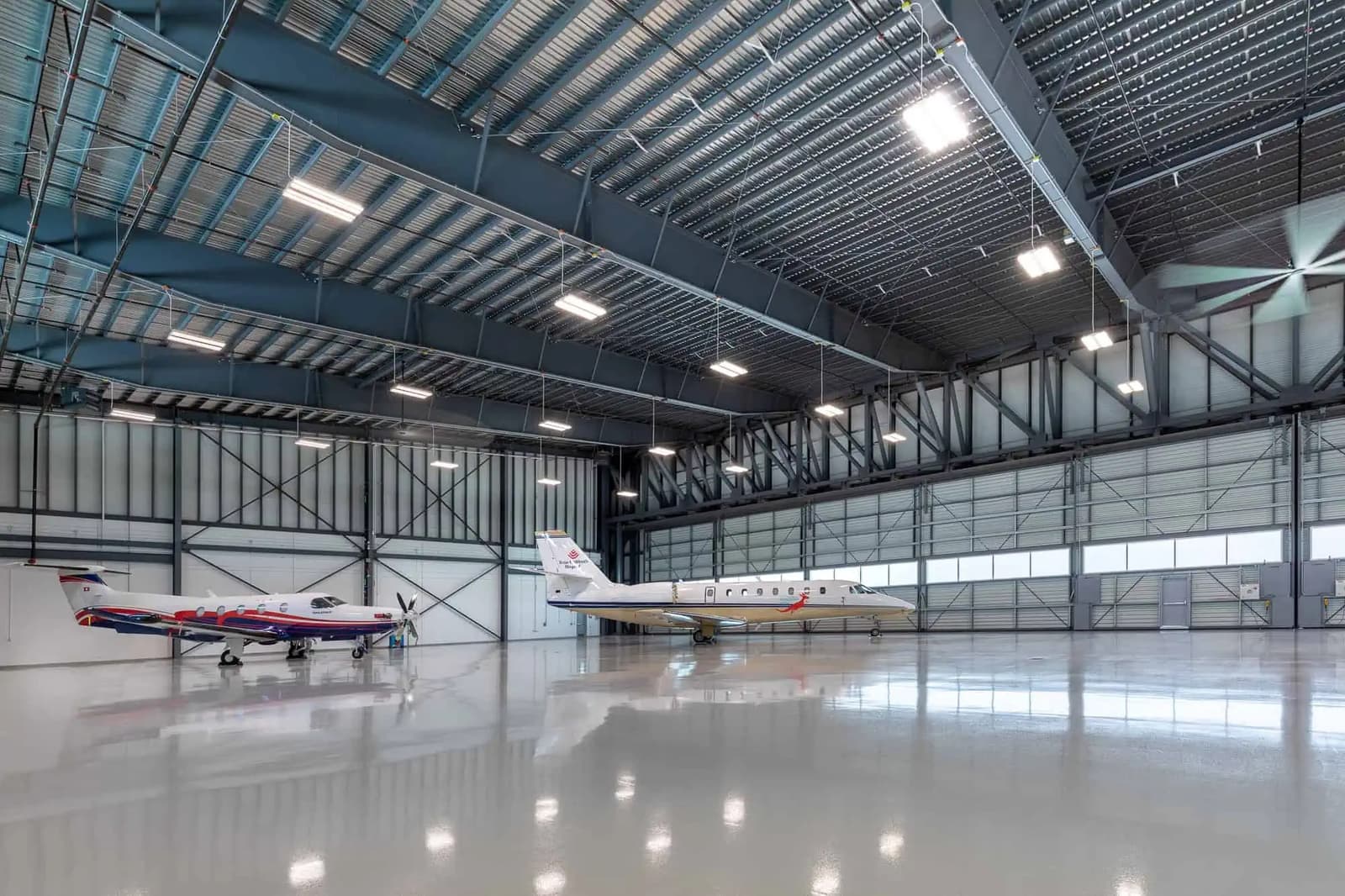
Airport Terminal and Aviation Facility Roofing in McAllen, TX
An airport does not stop so a roof can be replaced. McAllen International Airport (MFE), the Valley's gateway with regional service on American and United and a steady stream of cross-border business aviation, runs on its own clock, and that clock drives the entire project. Every access point, every crane lift, and every crew that sets foot on the property has to be cleared through the airport's facilities department and the FAA Part 139 safety program, with TSA security layered on wherever the work touches secured areas. We sort that coordination out before the contract is signed, because finding out about badging and escort requirements after mobilization is how an airport reroof falls weeks behind.
The demand here is real and ongoing. MFE's terminal and support buildings, combined with the Valley's heavy cross-border trade through the Hidalgo, Pharr, and Anzalduas bridges and the maquiladora-fed warehouse and cargo footprint around them, keep a consistent flow of aviation and aviation-adjacent roofing work moving, all of it under a high-heat, high-UV, high-humidity subtropical sky that is hard on membranes.
Big, Flat Roofs With No Margin for Ponding
Terminal roofs are large, low-slope expanses, and at that scale drainage is everything. A roof that holds even a shallow film of water bakes under the South Texas sun, ages the membrane fast, and adds dead load the structure was never meant to carry. We design these as tapered insulation systems that move water deliberately to the drains, because the ponding tolerance on a flat terminal roof is effectively zero. The membrane itself, usually a reflective TPO or PVC single-ply, also has to take a beating from the UV and heat load that come with this climate.
Wind, Jet Blast, and a Lot of Rooftop Equipment
Airside, the roof faces forces an ordinary commercial building never sees. Wind sweeps unobstructed across open airfield, and jet blast and prop wash put concentrated uplift on edges and corners, so the attachment and edge-metal specifications have to exceed what a comparable warehouse would need. Terminals also carry far denser and heavier mechanical equipment than a standard building, which means more curbed penetrations, more flashing, and more places to get the detail right or wrong. Our pre-project survey documents every penetration, curb height, and clearance, and the oversized equipment curbs get individually engineered flashing rather than a stock detail.
Keeping Water Out Over Active Passenger Space
A leak in a terminal is not a back-room inconvenience; it lands on a ticketing counter, a baggage belt, a security checkpoint, or the gate seating where passengers are waiting, and at MFE that space is in use at all hours. So the discipline that matters most on a terminal reroof is the daily dry-in. We never leave an open seam or an unsealed penetration over occupied passenger or operations space at the end of a shift, and the work is phased so that whatever is torn off in a given window is watertight again before the next bank of flights moves through underneath. Foreign-object debris is its own concern on an airfield, where a loose fastener or a scrap of membrane near a movement area is a genuine hazard, so our crews work to strict cleanup and containment standards on every airport job and account for every tool and piece of material before leaving the roof.
Cargo, Hangars, and the Rest of the Campus
The terminal is only part of the picture. Cargo buildings, rental-car facilities, FBO and aircraft-maintenance hangars, and other structures across an airport campus each bring their own roofing demands, and the badging and access requirement follows the crew everywhere on the property. High-bay hangars are their own challenge: a large clear-span roof over an open hangar bay generates serious wind uplift, so the fastening pattern and seam geometry have to be engineered for it, and standing-seam metal is often the right call on new high-bay structures. We handle those across McAllen and the wider Valley, and we plan the credentialing into the schedule from the start.
Airport & Aviation Roofing Questions
We build a phased work plan with the airport facilities department and the FAA Part 139 coordinator and get it approved by airport operations. Material deliveries, crane lifts, and any work near airside areas run during approved windows, with the NOTAM process coordinated where required. It is a standard part of how we set up an airport project, not an exception.
Most terminal reroofs here use a reflective TPO or PVC single-ply over a tapered insulation system built to drain and eliminate ponding. New high-bay aviation structures and hangars often call for standing-seam metal. The right choice depends on the existing deck, its load capacity, and operational constraints, so we develop the spec after walking the roof with your facilities engineer.
Terminal equipment density runs well above standard commercial. Our pre-project survey documents every penetration, curb height, and clearance before we build the work plan, and oversized equipment curbs and complex through-penetrations get individually engineered flashing rather than a stock detail.
Yes, with the right badging and full coordination with airfield operations. Airside work needs more pre-planning and crew credentialing, which we factor into the bid timeline, and we do not put a crew member airside without confirmed authorization. That is a baseline we enforce.
Yes. Hangar roofing, from a single-bay private hangar to a multi-unit FBO complex, is a regular part of our work in McAllen. High-bay hangars on wide-flange or pre-engineered steel generate strong uplift over the open bay, so we engineer the fastening pattern and seam geometry to handle the wind and thermal movement those structures see.
What we document
For Airport Terminal & Aviation Facility Roofing, we record field photos, roof observations, moisture concerns, access assumptions, excluded conditions, and the owner decision that moves the work forward.