Roofing the Largest Decks in the Valley Without Stopping the Line
McAllen sits on the U.S. side of one of the busiest automotive manufacturing clusters on the continent. The plants across the river in Reynosa feed a dense supplier base on this side, components warehouses, sequencing operations, and Tier 1 and Tier 2 plants spread through the Sharyland Business Park, the McAllen Foreign Trade Zone, and the industrial blocks off the I-2/US-83 corridor. These are big buildings running continuous shifts, and on a building like that a roofing-related interruption carries a cost-per-hour the plant's facilities engineers can quote you before the contract is signed. We understand what that number means, and it drives how we plan, mobilize, and sequence every project.
Big Decks Are a Logistics Problem Before They're a Roofing Problem
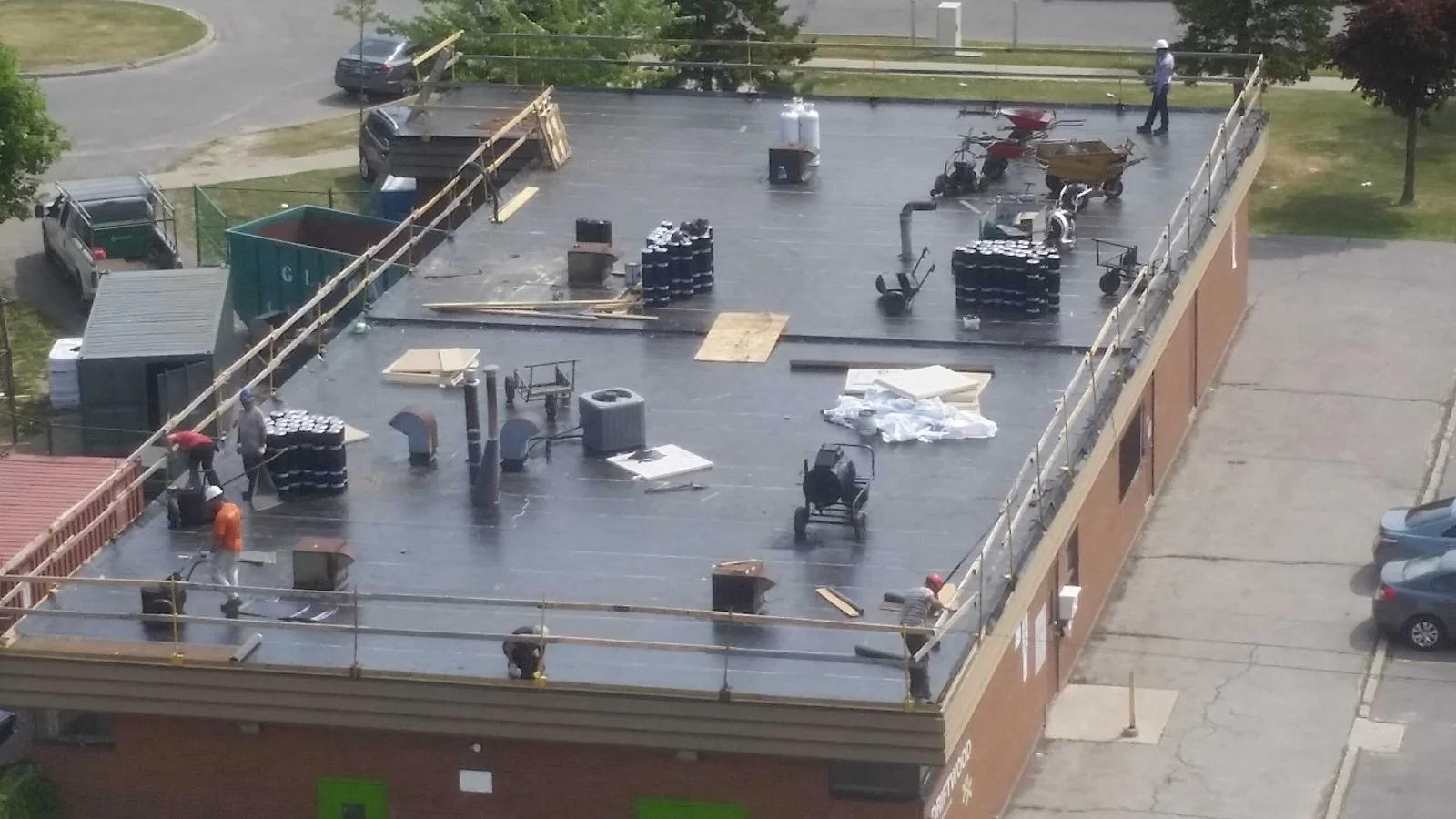
Automotive and supplier roofs run from hundreds of thousands of square feet up into the millions under a single envelope. You cannot tear off a roof that size in one push. We section it into manageable zones, sequence material delivery and tear-off to stay within crane reach and on-site storage limits, and keep production running in the adjacent zones while the active phase moves. The difference between a clean automotive reroof and a production-disrupting one is the logistics plan, and that plan gets built with the plant's facilities team before a single fastener is driven.
Paint Shop Zones Change the Rules
Paint operations are the most constrained roof zone in any assembly plant. Solvent vapor and the fire-suppression requirements around paint drive hot-work permitting, adhesive selection, and torch restrictions. We build the hot-work plan with the plant's environmental and safety team before anyone works above or next to paint, and we specify cold adhesive or mechanical attachment instead of anything torch-applied in those areas. Solvent-based adhesives have no place over active paint. None of this is a surprise on the job, it is standard scope planning for an automotive roof.
Press and Machining Vibration Reaches the Roof
Stamping, casting, and powertrain operations put real vibration into the structure, and it reaches the roof. A seam design that is fine on a quiet warehouse can fatigue over a heavy stamping press if it is welded or bonded without accounting for the load. We factor vibration exposure into the membrane specification and the welding procedures for press-adjacent zones so the seams hold up to the frequencies the equipment actually generates.
Ventilation, Process Loads, and Penetration Density
Manufacturing roofs carry heavy process exhaust, make-up air units, weld-smoke and fume extraction, and the conduit and piping that serve the floor below. Every one of those is a curb or penetration that has to be flashed individually and weighed against the deck's load capacity. On older decks we confirm what the structure can carry before we add insulation thickness, and we inventory and detail each penetration rather than running a repeat pattern across the building.
Membrane Systems for Large-Span Manufacturing
A 60- or 80-mil TPO mechanically attached is the common workhorse for large-span automotive decks here, with fully adhered systems in paint zones where the fastener pattern conflicts with hot-work restrictions. We add tapered insulation where drainage has gone bad over the years, and on load-limited decks we verify capacity before committing to an insulation buildup. The white membrane also helps with the cooling load these big buildings carry through a Valley summer.
Documentation Built to Corporate Standards
Closeout on an automotive facility is a deliverable in its own right: contractor safety qualifications, a site-specific safety plan, the OSHA log summary, warranty registration, a roof-zone diagram with the penetration inventory, daily work reports, permit records, and a photographed condition survey. OEM and large supplier facilities often want it formatted to their corporate facilities standard, and we provide it in the format each plant's engineering department requires.
Wind Uplift and Heat Across an Acre-Scale Roof
The sheer footprint of an automotive roof makes wind and heat first-order design concerns, not details. A roof measured in acres presents an enormous perimeter and corner area, and those are exactly the zones where the gusty Gulf-driven storms that cross the Valley in the warmer months drive the highest uplift pressures. On a deck this size a single under-fastened perimeter edge is where a storm starts a peel that can run, so we set the fastening density and the edge-metal detailing at the perimeter and corners to the uplift the building's height and exposure call for, and we confirm the existing deck can take those loads before we commit. Heat is the steady load: months of full South Texas sun bake a dark membrane and push cooling demand on the make-up air and process ventilation, so the white reflective TPO we favor on these decks both meets cool-roof energy expectations and helps hold rooftop and interior temperatures down across a building where conditioning that volume of air is already a major operating cost.
Automotive Manufacturing Roofing Questions
Production continuity governs every scope decision. Before mobilization we document the shift schedule with the plant's facilities team, identify which roof zones sit over active lines, and build a zone-by-zone phasing plan that keeps work clear of production. Dry-in is confirmed before each shift change and we keep direct contact with the maintenance foreman throughout.
Paint-zone hot work needs pre-approval from the plant's safety team before any torch, grinder, or welding is used above or near paint operations. We build the permit plan in pre-construction and specify cold adhesive or mechanical attachment where torch exclusions apply.
Typically 60- or 80-mil TPO mechanically attached, with fully adhered systems in paint zones where the fastener pattern conflicts with hot-work rules. Tapered insulation goes in where drainage has degraded, and we confirm deck capacity before adding insulation thickness on load-limited structures.
Yes. Supplier plants carry the same coordination demands as OEM facilities, often with just-in-time schedules that have zero tolerance for interruption. We document the production schedule, sequence around it, and stay in daily contact with the facilities lead the same way we do on a larger plant.
Contractor safety qualifications, the site-specific safety plan, OSHA log summary, warranty registration, a roof-zone diagram with penetration inventory, daily reports, permit records, and a photographed condition survey, formatted to the plant's corporate facilities standard when required.
What we document
For Automotive Manufacturing Facility Roofing, we record field photos, roof observations, moisture concerns, access assumptions, excluded conditions, and the owner decision that moves the work forward.