
McAllen's hotel market occupies a position unique in the American hospitality landscape: it serves both the Rio Grande Valley's medical tourism corridor, drawing patients from Mexico seeking US-based healthcare, and the cross-border retail and commercial traffic generated by McAllen's status as one of the busiest commercial ports of entry on the southern border. The Embassy Suites, Drury Inn, and the concentration of mid-scale properties along North 10th Street serve business travelers, medical escorts, and retail tourists in roughly equal measure, producing occupancy patterns that track healthcare appointment cycles, Mexican holiday calendars, and the peso-to-dollar exchange rate as closely as they track any US hospitality demand metric. For hotel roofing capital planning, this market's relative insensitivity to US seasonal patterns is a genuine advantage, occupancy stays more consistent year-round than in purely domestic markets.
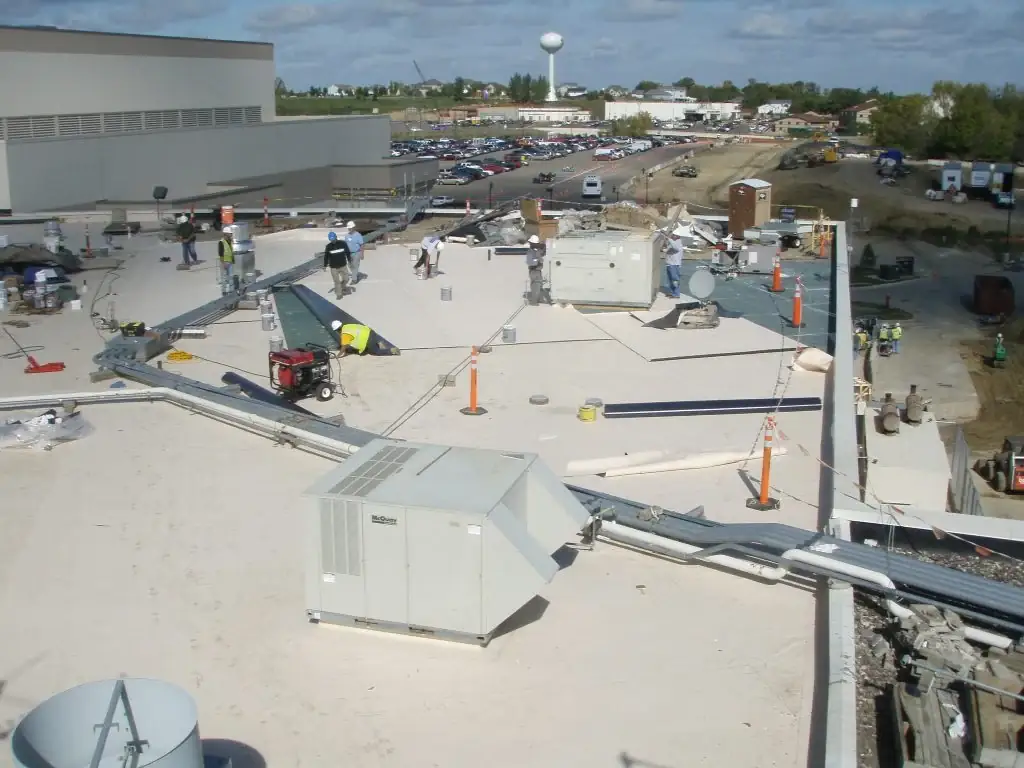
South Texas roofing conditions are dominated by heat, UV exposure, and the periodic but severe tropical weather events that affect the lower Rio Grande Valley. McAllen's position at the 26th parallel means it receives approximately 220 days of sunshine annually, with summer UV index levels that accelerate membrane surface oxidation and seam embrittlement faster than any other climate type. TPO membrane systems in McAllen face a degradation timeline roughly thirty percent shorter than the same product in a northern market if not maintained with periodic surface cleaning and seam inspection. White reflective membranes mitigate heat build-up but cannot eliminate the photodegradation effect of the region's UV intensity.
Tropical storm and hurricane threats require hotel roofing systems in McAllen to be specified for wind resistance appropriate to the lower Rio Grande Valley's exposure category. While McAllen is approximately sixty miles inland from the Gulf and does not face direct coastal storm surge, tropical systems that track through the region as they make landfall or weaken produce wind events that can challenge aging membrane systems with inadequate fastening. The 2019 and 2020 storm seasons brought repeated wind events to the Valley that exposed under-fastened mechanically attached systems at several commercial properties. Wind uplift design for hotel roofing in McAllen should reference Texas Department of Insurance windstorm certification requirements, particularly for properties that carry windstorm endorsements.
Property Improvement Plans at McAllen's branded hotels intersect with the city's medical tourism identity in ways that affect renovation timing. A hotel that has established relationships with McAllen Medical Center, Rio Grande Regional Hospital, or Doctors Hospital at Renaissance cannot afford roofing projects that compromise the quiet and professional atmosphere medical travelers expect. Patients recovering from procedures and families managing medical stress are not tolerant guests during construction disruptions, making noise management during any roofing project at a medically-positioned hotel a non-negotiable priority rather than a preference. Contractors who have worked at McAllen's medically-affiliated properties know this and plan accordingly.
Extended-stay properties in McAllen's medical corridor represent a significant share of the city's hotel inventory, with brands like Staybridge Suites, Homewood Suites, and Candlewood serving stays that often run two to four weeks as patients complete treatment protocols at the Valley's growing medical complex. These properties operate at high occupancy with minimal natural low-demand periods, making roof access planning a perpetual coordination challenge. The most practical maintenance approach for these properties is a preventive maintenance contract structured around early-morning weekend access windows when fewer guests are in rooms, combined with twice-yearly formal inspections that identify any conditions requiring more involved repair.
Flat roof drainage performance is particularly critical in McAllen given the region's intense but episodic rainfall patterns. South Texas can receive three to five inches of rain from a single tropical system in twenty-four hours, and roof drainage systems that perform adequately during typical rain events may be overwhelmed during these intense periods. Hotels that experience interior flooding from roof drain backup during storm events should investigate whether their drainage systems were sized for the local design storm intensity rather than a generic national standard. Undersized drains and insufficient secondary overflow capacity are among the most common conditions found during investigative inspections following storm-related hotel flooding in the lower Valley.
The cross-border business dimension of McAllen's hotel market means properties often host business travelers who are in the US for specific short-duration purposes, trade meetings, trade show attendance at the McAllen Convention Center, or legal proceedings, and who book hotel stays on very short lead times. This demand pattern means hotels rarely experience predictable multi-week lull periods during which interior disruption from roofing operations would go unnoticed. Roofing work on McAllen hotels requires the same noise and access management protocols as a fully urban property with year-round demand, even for properties that might appear to have more scheduling flexibility based on their suburban location.
Emergency roofing response after tropical weather events is a scenario McAllen hotel operators must plan for proactively. When a named tropical system threatens the lower Rio Grande Valley, local contractor capacity is immediately oversubscribed, everyone calls for emergency assessments simultaneously. Hotels with pre-established emergency contracts that include priority response protocols, pre-positioned materials for their specific membrane system, and documented temporary repair procedures are in meaningfully better position than those competing for contractor attention in the post-storm scramble. Establishing this relationship during a calm period, not after a system makes landfall, is the only approach that produces reliable response times.
Long-term roofing capital investment at McAllen hotels should account for the specific demands that the South Texas climate and the city's cross-border hospitality market place on roofing systems and contractors. UV-stabilized membrane formulations, wind uplift design that meets Texas windstorm certification standards, drainage systems sized for tropical intensity rainfall, and contractor relationships that include emergency response protocols represent the full framework for responsible roofing capital management in a market that sits at the intersection of the US hospitality industry and the unique economic and climate conditions of the lower Rio Grande Valley.
What we document
For Hotel and Hospitality Property Roofing, we record field photos, roof observations, moisture concerns, access assumptions, excluded conditions, and the owner decision that moves the work forward.