
McAllen's rapid growth as a binational commercial hub has fueled a new generation of mixed-use projects along the 10th Street corridor and near the La Plaza Mall redevelopment zone. Buildings that stack residential apartments or professional offices above ground-floor retail demand a level of roofing precision that standard commercial work rarely requires. The boundary between a tenant's living space and the commercial environment below creates unique moisture, thermal, and acoustic exposure points that must be resolved in the assembly itself, not patched after the fact.
The Rio Grande Valley's climate imposes severe ultraviolet exposure and prolonged heat that degrade standard roofing membranes faster than in more temperate markets. On McAllen mixed-use buildings, flat or low-slope decks over retail bays face sustained surface temperatures that can exceed 175°F in July and August. Thermoplastic polyolefin membranes with high solar reflectance are a reliable baseline, but the detailing at use-transition zones, where a rooftop residential deck transitions to a conventional mechanically fastened field, requires reinforced flashings and expansion provisions that account for differential thermal movement between substrates.
Waterproofing at the interface between commercial and residential uses is the single most consequential variable in McAllen mixed-use construction. When a restaurant occupies the ground floor and apartments sit directly above, grease-laden exhaust, condensate from commercial refrigeration, and foot traffic from rooftop amenity spaces all converge on the same membrane system. Two-ply modified bitumen assemblies with a separate traffic-bearing surfacing layer have performed well on local projects, provided the drain design keeps ponding water off the membrane field and the kitchen exhaust is routed through a dedicated curb that maintains the waterproofing plane.
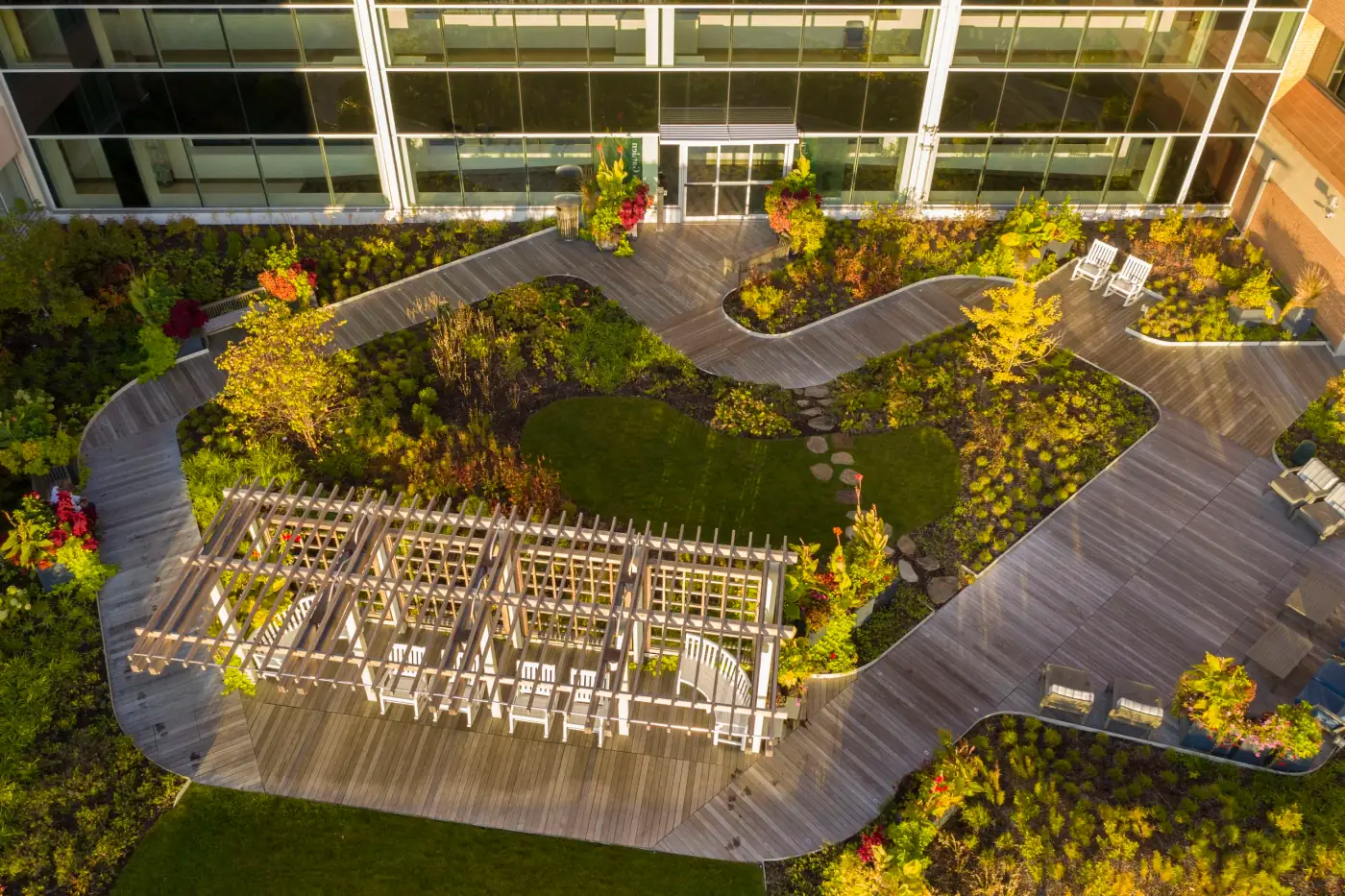
Several developments near the McAllen Transit Center and the planned downtown streetcar alignment have incorporated rooftop amenity decks as a selling point for upper-floor residential units. Pedestal-set paver systems are the most common finish, but beneath the pavers the waterproofing membrane and its protection course must be specified for foot traffic, point loads from furniture, and the thermal cycling that uncovered surfaces experience. Root barriers are equally important in McAllen, where residents frequently add container gardens and planters that, without proper separation, can perforate the membrane within a few growing seasons.
Fire-rated roof assemblies take on added complexity in mixed-use buildings because the International Building Code and Texas local amendments treat the occupancy separation between retail and residential as a two-hour assembly requirement in most configurations. That rating must be maintained continuously through the roof deck, including at all penetrations for HVAC, plumbing vents, and rooftop electrical equipment. Coordination between the roofing contractor, the mechanical trades, and the fire-rated assembly manufacturer's representative is not optional, it is a code compliance requirement that inspectors in Hidalgo County have been enforcing with increasing diligence on new downtown infill.
Noise isolation in McAllen mixed-use buildings is an underappreciated roofing variable, particularly for projects near McAllen-Miller International Airport's general aviation traffic and along heavily trafficked expressway corridors. A properly detailed roof assembly, incorporating adequate insulation thickness and a concrete or gypsum overlay board beneath the membrane, provides meaningful attenuation of airborne sound transmission into upper-floor units. Developers who treat roofing as a pure weatherproofing exercise often discover post-occupancy complaints about noise that require expensive remediation, so acoustic design should be integrated at the specification stage.
Humidity management is a persistent concern in the Valley. McAllen averages high relative humidity throughout the cooling season, and mixed-use buildings with large retail footprints generate significant internal moisture loads from HVAC systems, occupants, and cooking operations. Vapor retarder placement in the roof assembly must account for the direction of vapor drive, which reverses seasonally in South Texas. Getting this wrong produces interstitial condensation within the insulation layer, degrading R-value over time and eventually causing blistering or delamination of the membrane.
Long-term maintenance planning for McAllen mixed-use roofs requires a coordinated approach because multiple stakeholders, retail tenants, residential unit owners or managers, and the building HOA or property management company, may each claim jurisdiction over different portions of the roof. Establishing a clearly written maintenance agreement at the time of construction, with defined inspection intervals and a dedicated reserve fund allocation for roof replacement, prevents the disputes that commonly arise when a 20-year-old mixed-use roof finally fails and no party has been setting aside capital for replacement.
The commercial roofing contractors best suited to McAllen's mixed-use market understand the city's specific combination of intense UV, high humidity, hurricane-adjacent wind exposure, and the binational construction market that influences material supply and subcontractor availability. Specifying assemblies from manufacturers with regional technical representatives who can visit the site during critical installation phases, flashing, curb work, and drain installation, provides a level of quality assurance that matters on buildings where a roof failure affects both commercial tenants and residential occupants simultaneously.
What we document
For Mixed-Use Development Roofing, we record field photos, roof observations, moisture concerns, access assumptions, excluded conditions, and the owner decision that moves the work forward.