
Putting Solar on a McAllen Roof Without Voiding It
The phone calls we field about rooftop solar rarely start with the panels. They start with a stain on a warehouse ceiling, a tenant complaint, or an inverter tech who lifted a module and found the membrane weeping around a racking foot. By then the roof underneath is already compromised, and untangling that costs far more than getting it right before anything gets bolted down. We are the roofing half of a solar project: our job is to make sure the membrane, the deck, and the structure are ready to carry a photovoltaic system for its full twenty-five-year life, and that the panel installers do not quietly hand you a leak.
There is a lot of rooftop in this market that owners are eyeing for solar. The big-box and grocery-anchored centers along the 10th Street and Expressway 83 retail run, the cold-storage and produce-handling buildings clustered toward the Pharr-Reynosa International Bridge, and the manufacturing and logistics tenants out in the Sharyland and Mission industrial corridors all sit under wide, flat, low-slope roofs tailor-made for a sizable array. The Hidalgo County sun resource is one of the better ones in the state. The trouble is that the same sun, plus the heat and wind that ride with it, is brutal on any penetration or flashing detail done carelessly.
Get the Order of Operations Right
The most costly thing an owner can do is set an array on a membrane that has only a few years left. When that roof finally gives out, every module and rail has to come off, get stacked somewhere, and go back on after the tearoff, with the system re-wired and re-commissioned on top of that. The de-mount and reset alone can add a five-figure sum to a reroof that should have been straightforward, and the array sits dead the whole time it is on the ground. So before we talk racking, we ask the only question that matters first: how much honest service life is left in this roof?
We answer it with core cuts and an infrared scan, not a guess from the parapet. We pull plugs, look at the insulation, check the deck, and give you a real remaining-life number. From there the decision is simple:
Racking, Penetrations, and the Membrane Plane
An array gets held to a flat roof one of two ways, and each one rewrites the roofing scope. Ballasted racking rests the modules on weighted trays that stay put by sheer mass, which leaves the membrane unpierced but stacks a lot of dead load onto the structure. Mechanically attached racking screws into the deck through the roof, which is far easier on the structure but creates a sealed penetration at every single foot. Neither one is automatically correct here. The open terrain across Hidalgo County drives a lot of designs toward mechanical or hybrid attachment because pure ballast can come up short against Valley uplift pressures, and that is precisely where flashing discipline decides whether the roof stays dry.
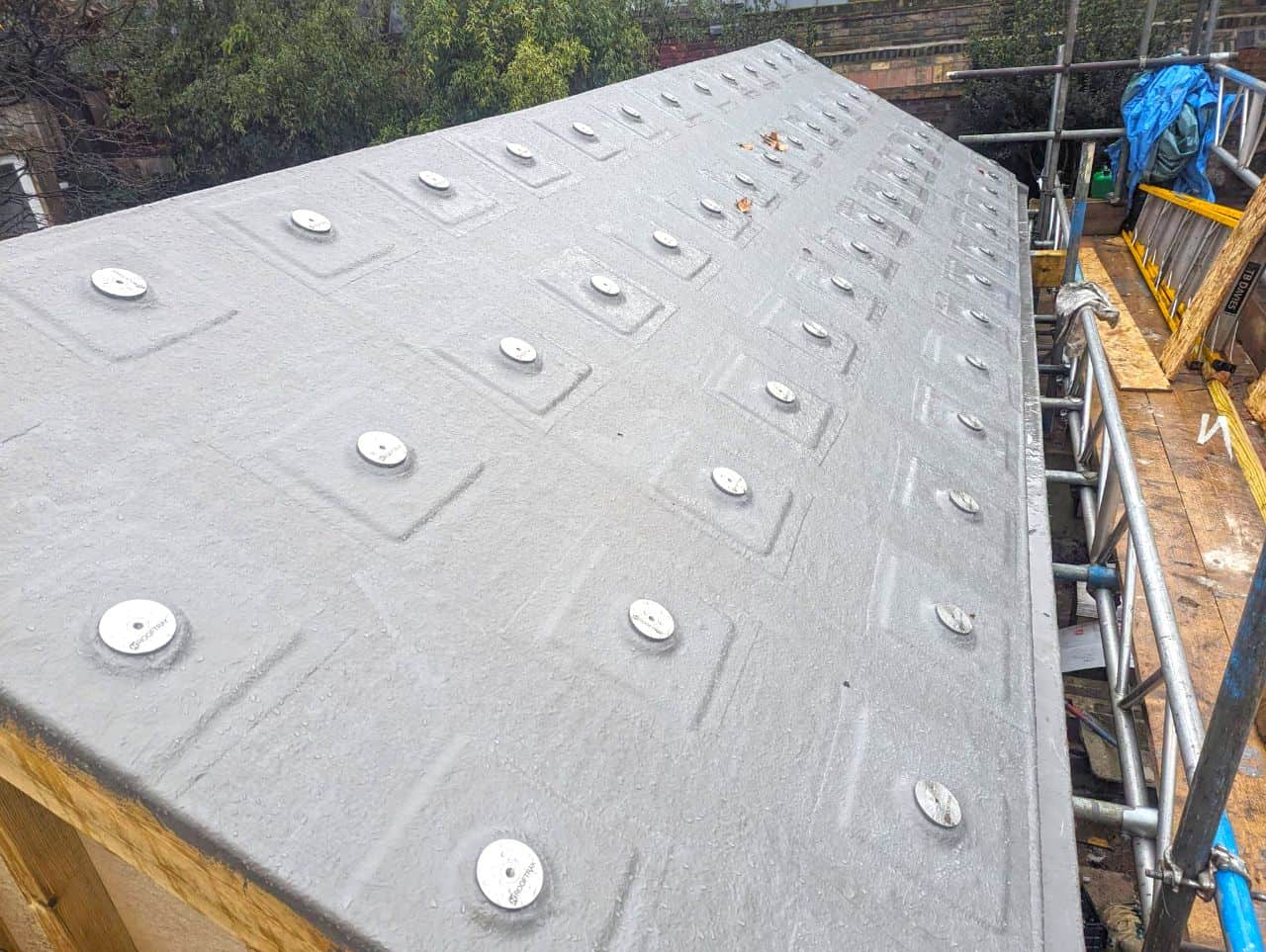
Every point where a fastener breaks the membrane plane is a future leak unless it is flashed to the membrane maker's published detail and welded back into the field sheet correctly. We treat racking feet, conduit stanchions, and combiner-box curbs the same way we treat any roof penetration: a proper base flashing, a target patch heat-welded or sealed to spec, and pipe supports that hold conduit up off the surface instead of letting it abrade the membrane every time the metal expands in the heat. The classic failure is a solar electrician running conduit flat across the sheet and strapping it down, where it saws a groove into the membrane inside of two or three summers. We settle that routing before the first rail goes up.
Dead Load and Uplift on Valley Structures
A ballasted layout lives or dies on two structural numbers: how much added dead load the building can actually carry, and how much wind uplift the array will catch. A lot of the older retail boxes and tilt-wall warehouses around McAllen were framed to lighter load allowances than a fully ballasted PV system puts on them, so the ballast plan has to be reconciled against the real structure rather than assumed safe. Uplift is the other half of the equation. The Rio Grande Valley sits in a wind-driven design zone, and a low array on a tall building sees serious pressure at the corners and along the edges. We work hand in hand with the racking engineer so ballast counts, attachment density, and how far the modules set back from the roof edge all reflect the genuine exposure of your building, not a repeat pattern stamped out for somewhere with calmer weather.
Making the Two Warranties Coexist
The warranty handoff is the seam where the roofer and the solar installer either cooperate or quietly set up to blame each other a few years later. The major single-ply manufacturers will keep a no-dollar-limit membrane warranty in force underneath an array, but only when the system goes in to their written requirements: approved ballast pads or attachment details, walkway protection on the service routes, every penetration flashed correctly, and a pre-installation review by their field representative. We run that review, document the details on the way, and get the manufacturer's sign-off in writing before a single module is set.
We do not sell solar, and that is the entire point of having us at the table. We represent the asset under the array. On a McAllen roof we will usually steer you toward a white reflective TPO or PVC field beneath the panels, because it pulls down the surface temperature the modules bake above and gives ballast a flat, uniform plane to sit on instead of a patchwork of old repairs.
Where the Roof Quietly Shapes the Solar Math
Commercial solar pencils out here partly on the raw strength of the sun and partly on incentives, and the roof sits silently under all of it. The long Valley cooling season means an array offsets power during the exact months your demand and your bills peak. But every one of those returns is figured over the life of the system, and if the roof underneath quits halfway through, the model breaks. The expense of pulling and resetting the array, plus the production lost while it sits offline, comes straight out of the savings you were counting on. That is why we frame roof readiness as part of the financial call, not a side chore for later.
We also chase down the practical details a financier's site survey tends to skim past. Is there clean, well-flashed roof access for the crews who will service this array for the next two decades. Will the existing drains and crickets keep moving water once rows of modules start shading and channeling runoff into new paths. We put those questions on the table before the array is engineered, so the solar plan is keyed to the roof instead of pretending the roof is not there.
How We Run Alongside Your Solar Crew
A project that goes smoothly has the roofing and PV trades talking before either one rolls a truck. We show up with the membrane manufacturer's requirements in hand, a firm position on ballast versus attachment for your structure and wind exposure, and a penetration-and-conduit plan that keeps the roof watertight. When a panel later has to come up for a module swap or an inverter service call, there is a documented detail telling everyone how to close it back up. That coordination is the whole difference between an array that quietly produces for twenty-plus years and one that turns into a leak hunt every time the rains come up from the Gulf.
If you are weighing solar on a building in McAllen, Edinburg, Mission, or Pharr, send the building location, the roof's age and membrane type if you know them, and the rough size of the array you are picturing. We will tell you whether the roof is ready, what it would take to get it ready, and how to stage the two projects so you are not paying to lift an array back off a few years down the road.
What we document
For Commercial Solar Roof Integration, we record field photos, roof observations, moisture concerns, access assumptions, excluded conditions, and the owner decision that moves the work forward.